
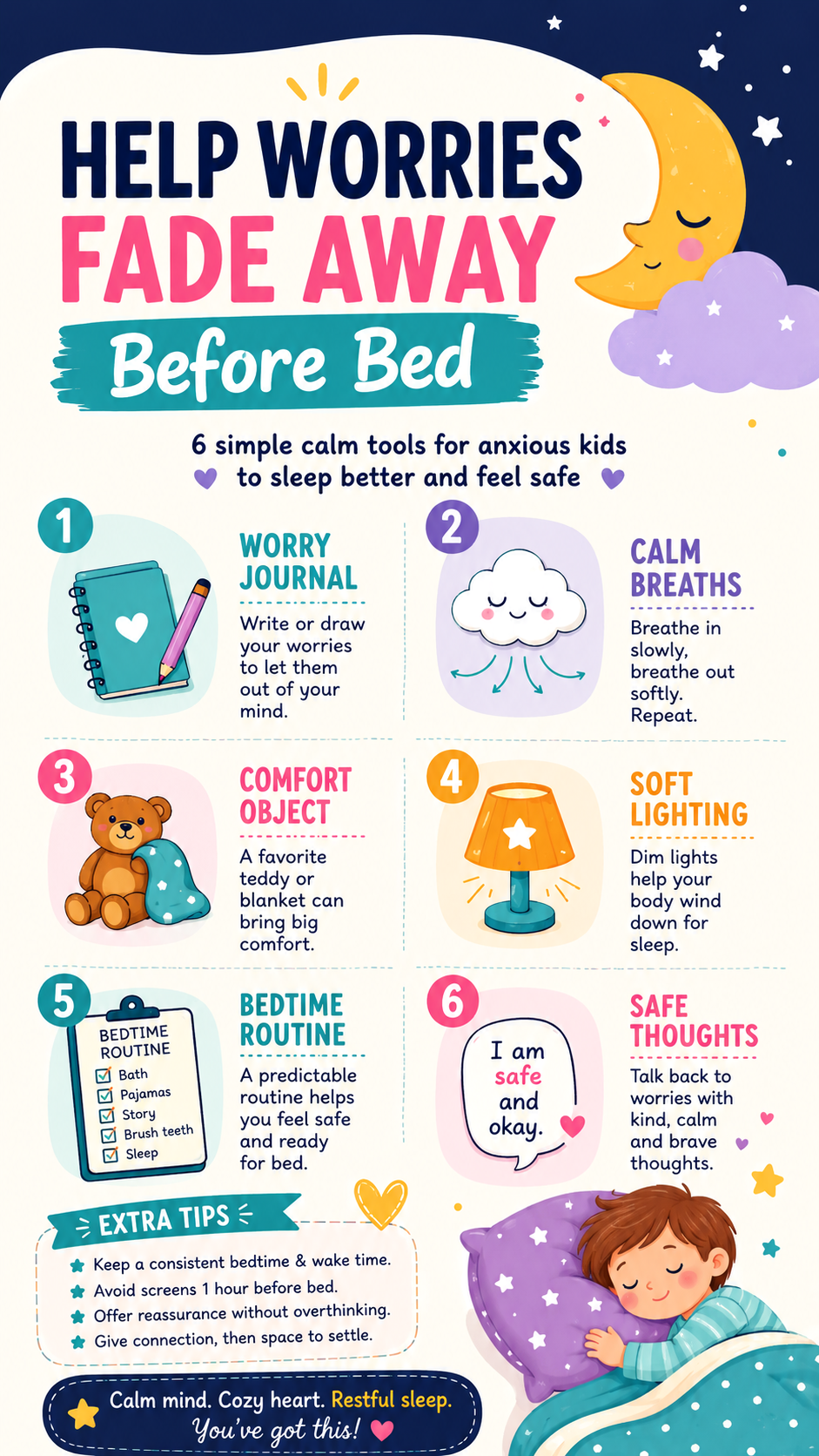
When a child seems exhausted but still cannot fall asleep, worries are often the hidden reason. Bedtime can amplify anxious thoughts because the distractions of the day fade away, leaving a child alone with concerns about school, friendships, family changes, fears, or imagined scenarios. What starts as a small worry during the day can feel much bigger when the lights go out.
Many parents experience the same frustrating cycle. A child asks repeated questions, calls out multiple times after being tucked in, struggles to settle, or becomes emotional as bedtime approaches. Fortunately, there are gentle, practical tools that can help children feel calmer, safer, and more confident before sleep.
This guide explores simple bedtime calm tools that support anxious children and create a more peaceful nighttime routine. These strategies encourage emotional regulation, reduce bedtime stress, and help children build healthy sleep habits that support long-term wellbeing.
Key Takeaways
- Bedtime worries are common among children and often intensify at night.
- Simple calming activities can help children process anxious thoughts.
- Consistent bedtime routines create a sense of safety and predictability.
- Comfort objects and calming breathing techniques can reduce stress.
- Limiting stimulation before bed supports better sleep quality.
- Small daily habits often produce the biggest long-term improvements.
Why Worries Feel Bigger at Bedtime
During the day, children are occupied with activities, conversations, schoolwork, and play. These experiences keep their minds engaged and often distract them from anxious thoughts. Once bedtime arrives, the quiet environment allows worries to move into the spotlight.
Children may worry about things that seem minor to adults but feel very real to them. They might think about making mistakes at school, being separated from loved ones, scary dreams, social situations, or future events they cannot control.
Understanding that bedtime anxiety is a genuine emotional experience helps parents respond with empathy rather than frustration. The goal is not to eliminate every worry immediately but to provide tools that help children feel capable of managing those feelings.
Important: Children often do not need their worries solved at bedtime. More often, they need reassurance, emotional support, and practical strategies that help their minds and bodies relax.
Creating a Worry Dump Routine
One effective strategy is encouraging children to transfer their worries from their minds onto paper before bed. This technique is often called a “worry dump.”
Provide a notebook, journal, or dedicated worry page and invite your child to write, draw, or list anything bothering them. Younger children who cannot write comfortably can draw pictures representing their feelings.
The process helps create psychological distance from anxious thoughts. Instead of carrying worries into bed, children learn that they can acknowledge and express them in a safe space.
How to Use a Worry Page
- Set aside five minutes before bedtime.
- Encourage honesty without judgment.
- Allow drawing, writing, or simple symbols.
- Thank your child for sharing their thoughts.
- Close the notebook as a symbolic way of leaving worries behind for the night.
This small habit can gradually reduce the mental load children carry into bedtime.
Using Calm Breathing to Relax the Body
Breathing exercises are among the simplest and most effective tools for calming an anxious nervous system. Slow, controlled breathing sends signals to the body that it is safe, helping reduce physical symptoms of stress.
Children often respond well to visual breathing prompts. They can imagine a cloud floating up and down, a balloon inflating and deflating, or a gentle wave moving across the shore.
Simple Bedtime Breathing Exercise
- Breathe in slowly through the nose for four counts.
- Pause briefly.
- Exhale gently through the mouth for four counts.
- Repeat five to ten times.
The focus should remain on comfort rather than perfection. Even a few slow breaths can help shift a child’s body from a state of tension to a state of calm.
Why This Matters
- Slow breathing helps reduce physical signs of anxiety.
- Children learn a self-regulation skill they can use independently.
- Regular practice improves bedtime confidence and emotional resilience.
The Comfort of Familiar Objects
Comfort objects often play a valuable role in helping children feel secure. A favorite teddy bear, blanket, pillow, or stuffed animal can provide emotional reassurance during vulnerable moments.
These items are more than toys. They often become symbols of safety and familiarity. For many children, holding a trusted comfort object reduces stress and creates a sense of emotional stability.
Parents should avoid pressuring children to give up comfort objects too early. As children develop emotional confidence, reliance on these items typically decreases naturally.
Pro Tip: Consider creating a bedtime comfort basket containing a favorite stuffed animal, a soft blanket, and a calming bedtime book. Having these items together can become a reassuring part of the nightly routine.
Why Lighting Can Influence Sleep
The sleep environment has a significant impact on a child’s ability to relax. Bright lights and overstimulating surroundings can make it harder for children to transition into sleep mode.
Soft, warm lighting encourages relaxation and signals to the brain that bedtime is approaching. Gentle bedside lamps, dim lights, or low-intensity nightlights can help create a soothing atmosphere.
While some children prefer complete darkness, others feel more comfortable with a small amount of light. Finding the right balance can reduce nighttime fears and support better sleep.
Bedroom Environment Tips
- Use warm, gentle lighting before bed.
- Reduce household noise when possible.
- Keep the room comfortably cool.
- Limit bright screens and electronic devices.
- Create a calm, uncluttered sleeping space.
The Power of Predictable Bedtime Routines
Children thrive on predictability. Knowing exactly what happens before bed helps reduce uncertainty and creates a sense of control.
A bedtime routine does not need to be complicated. Consistency matters far more than perfection. The same sequence repeated each evening can become a powerful signal that sleep is approaching.
Sample Bedtime Routine
- Bath or wash-up time
- Put on pajamas
- Brush teeth
- Read a story
- Practice calm breathing
- Goodnight hug and lights out
Following a predictable routine reduces decision fatigue and helps children feel secure as they prepare for sleep.
Important: Consistency is often more effective than length. A simple routine repeated every night usually works better than a complex routine that changes frequently.
Teaching Safe and Calming Thoughts
Anxiety often involves focusing on frightening possibilities. Teaching children to replace fearful thoughts with calming alternatives can be extremely helpful.
This does not mean pretending fears do not exist. Instead, it involves gently redirecting attention toward realistic, reassuring thoughts.
Examples of Safe Thoughts
- I am safe in my bed.
- My family is nearby.
- I know how to calm my body.
- Tomorrow is a new day.
- I can handle difficult feelings.
Repeating these statements regularly helps children develop healthier internal dialogue and greater emotional confidence.
Reducing Screen Time Before Bed
Many children use tablets, phones, televisions, or gaming devices during the evening. While these activities may seem relaxing, they can interfere with healthy sleep patterns.
Fast-paced content keeps the brain engaged and may increase emotional stimulation. Bright screens can also affect natural sleep signals.
Whenever possible, replace screen time during the hour before bed with quieter activities such as reading, drawing, puzzles, gentle conversation, or calming music.
Better Evening Alternatives
- Reading together
- Coloring activities
- Listening to calm stories
- Practicing gratitude
- Simple stretching exercises
Offering Reassurance Without Over-Questioning
Parents naturally want to understand every detail of their child’s worries. However, repeatedly asking questions late at night can sometimes increase focus on anxious thoughts.
Instead of launching into lengthy discussions, offer calm reassurance and acknowledge emotions without amplifying them.
Helpful responses include:
- “That sounds hard.”
- “I can see you’re feeling worried.”
- “You are safe right now.”
- “Let’s use one of our calming tools.”
- “We can talk more about this tomorrow.”
This approach validates emotions while helping children move toward rest rather than deeper rumination.
Helping Children Build Long-Term Emotional Skills
Bedtime calm tools are valuable not only for sleep but also for emotional development. As children practice coping strategies, they learn important life skills that extend beyond the bedroom.
They begin to recognize emotions, manage stress, communicate concerns, and develop confidence in their ability to handle challenges.
Over time, these skills can strengthen resilience and improve overall mental wellbeing.
Pro Tip: Introduce calming tools during the day as well. Practicing when children are already relaxed makes it easier for them to use the techniques successfully when anxiety appears.
At a Glance
- Use a worry journal to release anxious thoughts.
- Practice slow breathing before lights out.
- Encourage comfort objects when needed.
- Create a predictable bedtime routine.
- Replace scary thoughts with calming statements.
Conclusion
When children struggle to sleep because of worries, the solution is rarely found in a single technique. Instead, meaningful progress often comes from combining several gentle strategies that help children feel safe, understood, and supported.
Simple tools such as worry journals, calming breathing exercises, comfort objects, soft lighting, predictable bedtime routines, and reassuring self-talk can make a remarkable difference. These approaches help children develop healthier sleep habits while also strengthening emotional resilience.
With patience, consistency, and a supportive environment, bedtime can gradually become a calmer and more peaceful experience. Small changes practiced regularly can help anxious children settle more easily, sleep more soundly, and wake feeling refreshed and ready for the day ahead.
Tags
Bedtime Anxiety Anxious Kids Sleep Tips for Children Calm Bedtime Routine Child Sleep Support Parenting Tips Kids Mental Wellness Healthy Sleep Habits