
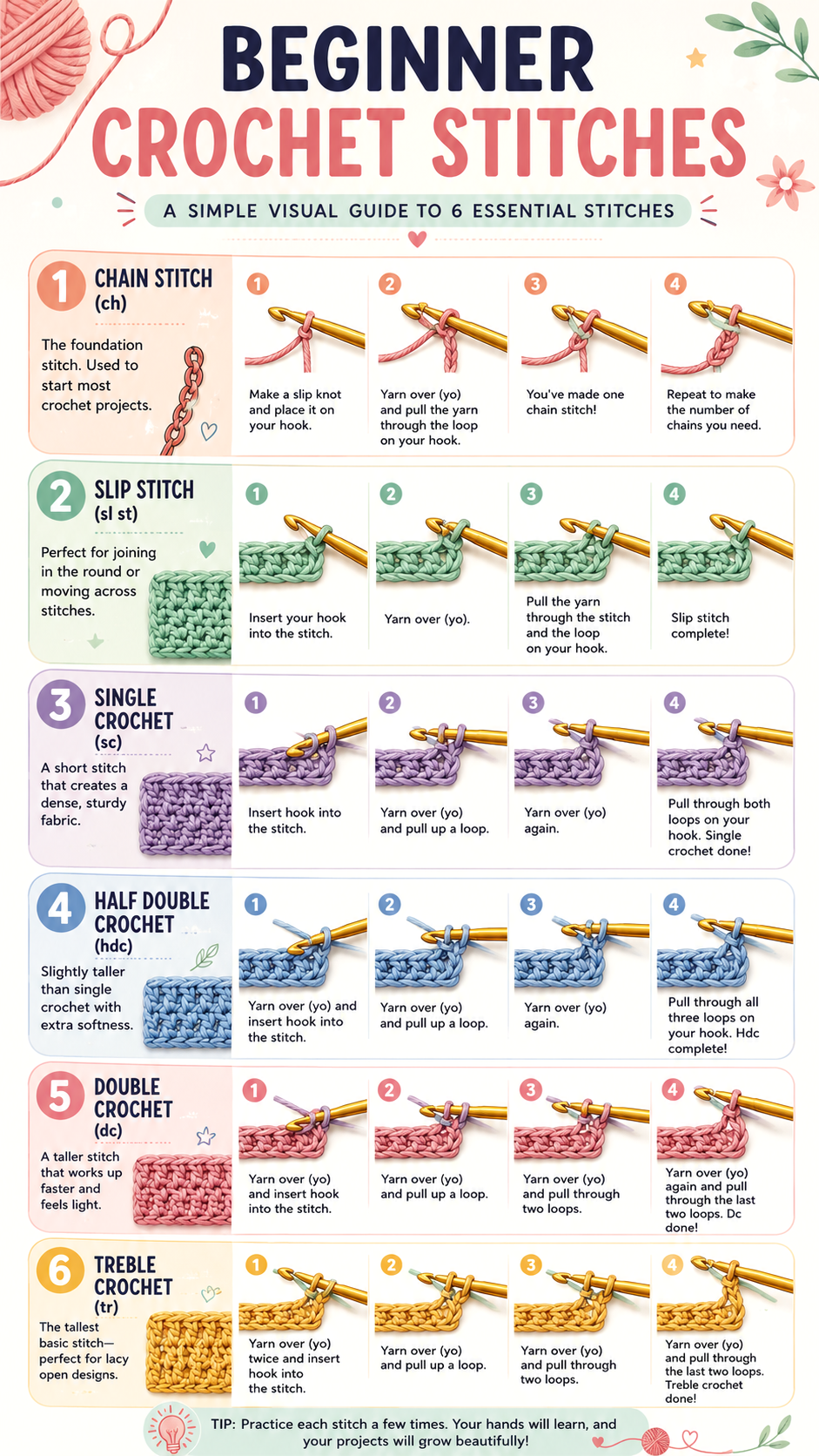
Crochet basics are much easier to learn when the stitches are broken down into clear, beginner-friendly steps. Before you start making blankets, scarves, dishcloths, amigurumi, or decorative home projects, it helps to understand the foundation stitches that appear in almost every crochet pattern. The most useful beginner stitches include the chain stitch, slip stitch, single crochet, half double crochet, double crochet, and treble crochet. Once these stitches feel familiar, reading patterns becomes less intimidating and your hands begin to move with more confidence.
This guide walks through the essential crochet stitches every beginner should know, explains what each stitch is used for, and shares practical tips for practicing them. Whether you are holding a crochet hook for the first time or refreshing your skills after a break, these crochet basics will help you build a strong foundation for future handmade projects.
Key Takeaways
- The chain stitch is the foundation for most beginner crochet projects.
- Slip stitch is useful for joining rounds, finishing edges, and moving across stitches.
- Single crochet creates a dense, sturdy fabric that is great for beginners.
- Half double crochet and double crochet add height while keeping projects flexible.
- Treble crochet creates tall, open stitches that work well for airy designs.
- Practicing each stitch slowly helps improve tension, rhythm, and stitch consistency.
Why Learning Crochet Basics Matters
Every beautiful crochet project starts with a few simple movements: yarn over, insert the hook, pull up a loop, and pull through. These actions repeat in different combinations to create texture, height, structure, and pattern. When beginners try to jump straight into a complex project without understanding basic crochet stitches, the process can feel confusing. Learning the stitches one by one makes crochet feel manageable and enjoyable.
Think of crochet basics like the alphabet of yarn craft. Once you know the letters, you can form words, sentences, and eventually full stories. In crochet, stitches are the building blocks. A scarf may use rows of double crochet. A plush toy may rely on single crochet. A lacy shawl may use treble crochet. Even decorative borders often use chain stitches and slip stitches.
Important: The goal is not to make perfect stitches immediately. The goal is to understand how each stitch works, practice the hand motion, and build a steady rhythm. Consistency comes with repetition.
Essential Crochet Tools for Beginners
Before practicing beginner crochet stitches, gather a few simple supplies. You do not need a large collection of hooks or expensive yarn to get started. A medium-weight yarn and a comfortable crochet hook are enough for learning the basics.
Choose a Comfortable Crochet Hook
A smooth crochet hook helps yarn glide easily. Many beginners like aluminum, plastic, or ergonomic hooks because they are lightweight and easy to hold. The hook size should match your yarn label, but for practice, a medium hook is usually easier to control than a tiny one.
Pick Beginner-Friendly Yarn
Choose a light-colored yarn so you can clearly see each stitch. Very dark yarn can make it difficult to identify loops, especially when you are just starting. A smooth, medium-weight yarn is ideal because it is not too thin, too fuzzy, or too slippery.
Keep Scissors and Stitch Markers Nearby
Small scissors are useful for trimming yarn ends. Stitch markers can help you mark the first stitch in a row or round, especially when working on patterns later. For now, they are optional, but they become very helpful as your crochet skills grow.
Understanding Common Crochet Terms
Many crochet patterns use abbreviations instead of full stitch names. Learning these abbreviations early makes patterns easier to read. The most common beginner crochet abbreviations include ch for chain stitch, sl st for slip stitch, sc for single crochet, hdc for half double crochet, dc for double crochet, and tr for treble crochet.
You will also see the term yo, which means yarn over. This simply means wrapping the yarn over your crochet hook before pulling it through a loop or stitch. Yarn over appears in nearly every basic crochet stitch, so it is one of the most important motions to practice.
Chain Stitch: The Foundation of Crochet
The chain stitch, abbreviated as ch, is usually the first stitch beginners learn. It creates a series of linked loops that form the starting base for many crochet projects. If you are making a scarf, blanket, dishcloth, or simple rectangle, your pattern will often begin with a chain.
To make a chain stitch, start with a slip knot on your hook. Yarn over, then pull the yarn through the loop on your hook. That creates one chain. Repeat the same motion until you have the number of chains needed for your project.
Tips for Practicing Chain Stitch
- Keep your chains relaxed, not too tight.
- Try to make each chain the same size.
- Practice counting chains from the front and back.
- Make a long chain, then unravel it and try again.
Pro Tip: If your first row feels too tight, your starting chain may be too snug. Try using a slightly larger hook for the foundation chain, then switch back to your regular hook for the rest of the project.
Slip Stitch: Small but Very Useful
The slip stitch, abbreviated as sl st, is one of the shortest crochet stitches. It does not add much height, which makes it useful for joining rounds, closing gaps, moving across stitches, and creating neat edges. Even though it is simple, the slip stitch appears in many beginner and advanced crochet patterns.
To make a slip stitch, insert your hook into the stitch, yarn over, and pull the yarn through both the stitch and the loop on your hook. The movement is quick and compact.
When to Use Slip Stitch
Slip stitch is commonly used to join the end of a round to the beginning, especially in hats, granny squares, coasters, and circular motifs. It can also help create decorative surface crochet or smooth edging. Because it is so low in height, it keeps the fabric flat and tidy.
Single Crochet: Dense, Simple, and Beginner Friendly
Single crochet, abbreviated as sc, is a compact stitch that creates a dense and sturdy fabric. It is one of the most common crochet stitches for beginners because it is easy to learn and useful in many projects. Single crochet works well for washcloths, bags, baskets, amigurumi, coasters, and simple home decor pieces.
To make a single crochet stitch, insert your hook into the stitch, yarn over, and pull up a loop. You will have two loops on your hook. Yarn over again and pull through both loops. That completes one single crochet.
Why Beginners Should Practice Single Crochet
Single crochet teaches you how to insert the hook into stitches, control yarn tension, and complete a full stitch with a simple sequence. Because it creates a firm fabric, mistakes are easier to notice and correct. Practicing rows of single crochet is one of the best ways to improve control.
Expert Insight
If your single crochet fabric leans, curls, or feels uneven, do not worry. Beginners often crochet tighter at the beginning and loosen up as they relax. Make a small practice swatch and focus on steady hand movement instead of speed.
Half Double Crochet: Soft Height and Easy Texture
Half double crochet, abbreviated as hdc, is slightly taller than single crochet but shorter than double crochet. It creates a soft, balanced fabric with a little more height and drape. Many beginners enjoy half double crochet because it works up faster than single crochet while still feeling easy to control.
To make a half double crochet, yarn over first, then insert your hook into the stitch. Yarn over again and pull up a loop. You will have three loops on your hook. Yarn over once more and pull through all three loops.
Best Projects for Half Double Crochet
Half double crochet is wonderful for scarves, baby blankets, headbands, simple sweaters, and textured home accessories. It creates a fabric that feels cozy without being too stiff. If you want a beginner stitch that is simple but not too slow, half double crochet is a great choice.
Double Crochet: A Taller Stitch That Works Up Fast
Double crochet, abbreviated as dc, is taller than single crochet and half double crochet. It creates a more open fabric and helps projects grow quickly. This stitch is often used in blankets, shawls, scarves, cardigans, granny squares, and many classic crochet patterns.
To make a double crochet, yarn over and insert your hook into the stitch. Yarn over again and pull up a loop. You will have three loops on your hook. Yarn over and pull through two loops. Yarn over once more and pull through the last two loops.
Why Double Crochet Is So Popular
Double crochet is popular because it creates height quickly. It is also flexible enough for many stitch patterns. Once you understand double crochet, you can start learning shell stitches, V-stitches, granny clusters, and other decorative techniques that build from the same basic motion.
Important: Double crochet often needs turning chains at the beginning of rows. Always check whether your pattern counts the turning chain as a stitch, because this can affect stitch count and edge shape.
Treble Crochet: Tall, Open, and Decorative
Treble crochet, abbreviated as tr, is one of the tallest basic crochet stitches. It creates an open, airy fabric and is often used in lacy patterns, decorative designs, lightweight shawls, and textured borders. Treble crochet may feel a little awkward at first because it has more loops on the hook, but the steps are still easy to follow with practice.
To make a treble crochet, yarn over twice before inserting your hook into the stitch. Yarn over and pull up a loop. You will have four loops on your hook. Yarn over and pull through two loops. Repeat this process until only one loop remains on the hook.
When to Try Treble Crochet
Try treble crochet after you feel comfortable with double crochet. It uses a similar idea, but with one extra yarn over at the start and more pull-through steps. It is excellent for projects where you want height, movement, and a lighter texture.
How to Practice Crochet Stitches Without Getting Overwhelmed
Learning crochet basics is more enjoyable when you practice in small sections. Instead of trying to master every stitch in one sitting, focus on one stitch at a time. Make a small swatch with several rows, look at the shape of the stitches, then move on to the next stitch.
Start With a Simple Practice Swatch
Make a foundation chain of about 15 to 20 stitches. Work several rows of one stitch, such as single crochet. Once the fabric begins to look consistent, try the same number of rows in half double crochet, double crochet, and treble crochet. This helps you compare stitch height and texture.
Count Your Stitches Often
Many beginners accidentally add or lose stitches at the edges. Counting your stitches at the end of each row helps you catch mistakes early. If a row has too many stitches, you may have worked into the turning chain or added an extra stitch at the end. If it has too few, you may have skipped the first or last stitch.
Pay Attention to Tension
Tension is how tightly or loosely you hold the yarn. Tight tension can make it hard to insert the hook. Loose tension can make stitches uneven. Aim for a relaxed grip. The yarn should move smoothly through your fingers without being pulled too tight.
Common Beginner Crochet Mistakes
Every beginner makes mistakes, and most crochet mistakes are easy to fix. The key is learning what to look for.
Making the Foundation Chain Too Tight
A tight foundation chain can make the first row frustrating. If you struggle to insert your hook into the chain, loosen your hand or use a larger hook for the starting chain.
Skipping the Last Stitch
The last stitch in a row can be hard to see. This is why edges sometimes shrink inward. Using a stitch marker can help you identify the first and last stitch of each row.
Confusing Stitch Abbreviations
Crochet abbreviations can feel confusing at first. Keep a small reference nearby until the terms become familiar. Seeing sc, hdc, and dc repeatedly will make them easier to remember.
Best Beginner Projects for Practicing Crochet Basics
Once you understand the essential stitches, choose small projects that let you repeat them. Repetition builds muscle memory and helps your stitches become more even.
Dishcloths and Washcloths
Dishcloths are excellent beginner crochet projects because they are small, useful, and forgiving. You can make one using only single crochet or half double crochet.
Simple Scarves
A scarf gives you plenty of practice with repeated rows. Double crochet works especially well for a quick beginner scarf because it adds height faster than shorter stitches.
Coasters and Small Squares
Coasters are great for practicing stitch count, edges, and finishing. Small squares also help you compare how different stitches look and feel.
A Simple Practice Idea
Make six small swatches, one for each basic crochet stitch: chain, slip stitch, single crochet, half double crochet, double crochet, and treble crochet. Label them or keep them in a small crochet journal so you can compare texture, height, and drape.
At a Glance
- Best first stitch: Chain stitch
- Best sturdy stitch: Single crochet
- Best soft beginner stitch: Half double crochet
- Best fast-growing stitch: Double crochet
- Best open texture stitch: Treble crochet
Conclusion: Build Confidence One Stitch at a Time
Crochet basics are the foundation for almost every project you will make. By learning chain stitch, slip stitch, single crochet, half double crochet, double crochet, and treble crochet, you give yourself the skills needed to follow beginner patterns and explore new creative ideas. Each stitch has its own purpose, texture, and rhythm, and practicing them slowly will help your hands learn what your mind is trying to understand.
The best way to improve is to keep your hook and yarn nearby, practice a few rows at a time, and celebrate small progress. Uneven stitches, loose edges, and tight chains are all part of learning. With patience and repetition, crochet becomes smoother, calmer, and much more enjoyable. Start with these essential crochet stitches, build simple swatches, and let each practice session bring you closer to your next handmade project.
Tags
Crochet Basics Beginner Crochet Crochet Stitches Crochet Tutorial Yarn Crafts Easy Crochet Crochet Guide Handmade Projects