
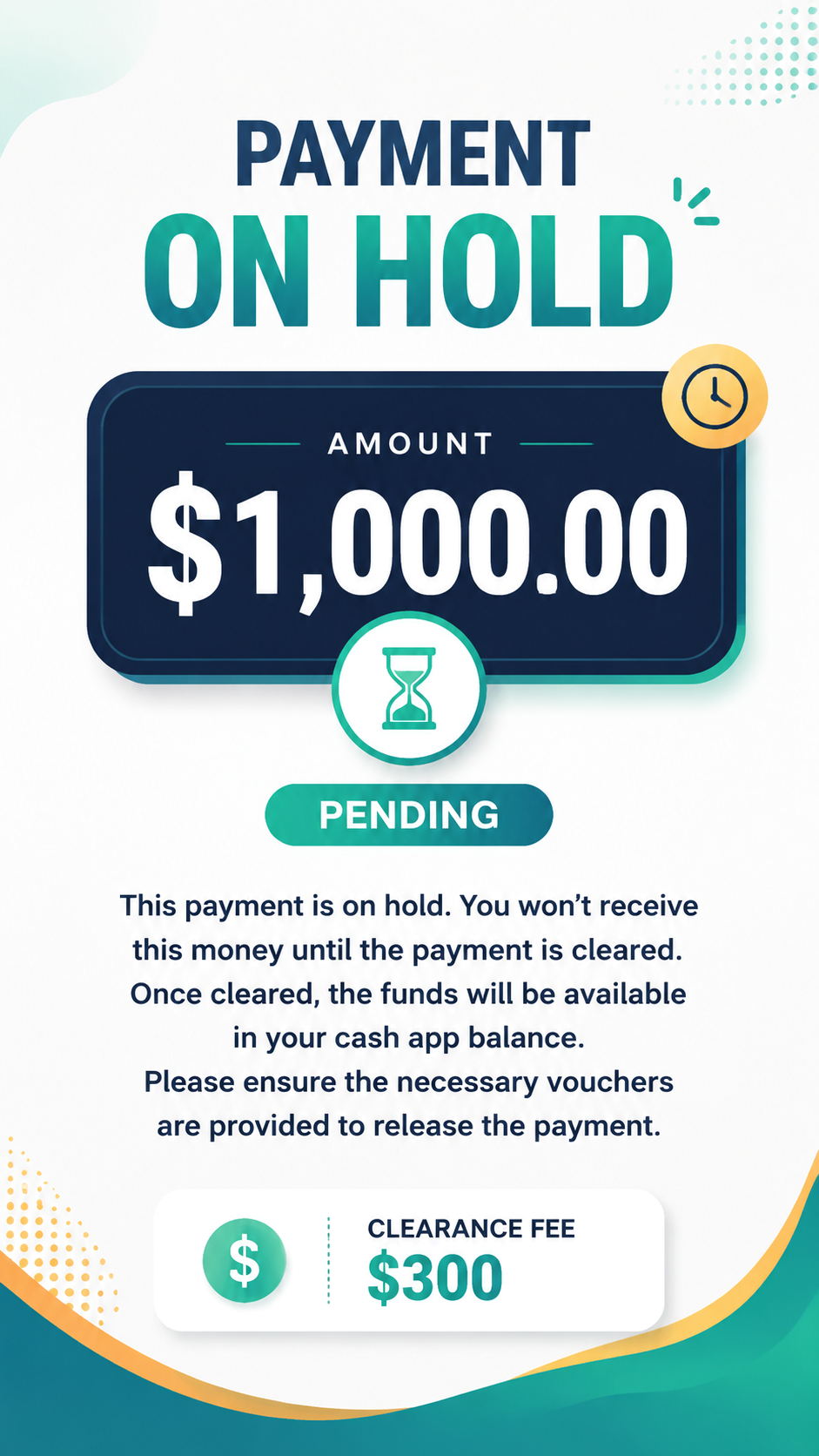
This image highlights a common financial scam style message that imitates payment apps and online money transfers. It displays a supposed “$1,000.00 pending payment” with a fake “clearance fee” request of $300, warning that the user cannot access funds until they pay. At first glance, it may look like a legitimate payment notification, but it is actually a classic example of a payment hold scam designed to trick users into sending money or sharing sensitive information.
Key Takeaways
- This is a fake payment notification scam designed to steal money
- Legitimate apps never ask for “clearance fees” to release funds
- Scammers use urgency and large amounts to create emotional pressure
- Messages often mimic trusted platforms like Cash App or banking apps
- Users are tricked into sending money or sharing banking details
Understanding the Fake Payment Hold Message
The visual shows a fabricated transaction alert claiming that a payment of $1,000 is pending and temporarily on hold. The message is written in a way that appears urgent and authoritative, instructing the user to “clear the payment” by paying a $300 fee. It even suggests linking bank information and providing vouchers, which are common manipulation tactics used in fraud schemes.
Important: Real financial platforms such as Cash App, PayPal, or banks never require users to pay additional fees to release pending funds. Any message requesting upfront payment to unlock money is a strong indicator of fraud.
How This Type of Scam Works
Scammers design these fake notifications to look like official payment alerts. They often use clean layouts, recognizable dollar amounts, and fake status indicators like “Pending” or “On Hold” to build trust quickly.
Once the user believes money is waiting for them, the scammer introduces a barrier such as a “clearance fee,” “verification charge,” or “account upgrade fee.” This is where victims are pushed to send real money in hopes of unlocking fake funds.
Pro Tip: If someone claims you must pay money to receive money, it is almost always a scam. Legitimate financial systems deduct fees automatically or do not require manual payment for release.
Why People Fall for Payment Hold Scams
These scams are effective because they exploit emotion and urgency. Seeing a large pending amount like $1,000 triggers excitement and trust. At the same time, the idea of “losing” the money creates pressure to act quickly without verifying the message.
Scammers also rely on users being unfamiliar with how real payment systems work. Many people do not know that legitimate platforms never ask for “vouchers” or external payments to unlock funds.
Another key factor is presentation. The layout mimics modern app interfaces, making it harder for inexperienced users to recognize the fraud immediately.
Why This Matters
Fraudulent payment screens like this are increasingly shared through social media, messaging apps, and fake customer support accounts. Understanding how they operate helps users avoid financial loss and protect sensitive banking information.
Common Red Flags in the Image
There are several warning signs in this type of message that immediately indicate a scam attempt:
- Requests for a “clearance fee” or upfront payment
- Urgent language designed to pressure quick action
- Claims that funds are blocked until external steps are completed
- Instructions to link bank details through unofficial methods
- Unprofessional wording and inconsistent platform branding
Important: Real payment apps provide clear transaction histories and never require users to pay extra to access their own funds.
How Legitimate Payment Systems Actually Work
Understanding how real platforms operate helps you easily identify scams. Services like Cash App, PayPal, and traditional banks follow strict financial regulations. Any pending transaction is handled internally without requiring user intervention in the form of additional payments.
Fees, if they exist, are deducted automatically from transactions or shown transparently before sending money. There is no scenario where a user must “unlock” money by sending another payment to an unknown source.
Pro Tip: Always verify transaction status directly inside the official app instead of trusting screenshots, emails, or messages.
What To Do If You Encounter This Scam
If you come across a message like the one shown in the image, the safest action is to ignore it immediately. Do not click any links, send money, or share personal details.
Instead, report the message to the platform it is impersonating. Most payment services have built-in fraud reporting tools that help protect other users from similar scams.
It is also recommended to block the sender and run a security check on your accounts if you have interacted with the message in any way.
How to Protect Yourself From Payment Scams
Online financial scams continue to evolve, but basic safety habits can significantly reduce risk. Awareness and caution are your strongest defenses.
Always double-check payment notifications directly in official apps. Avoid trusting screenshots or forwarded messages. Be skeptical of any request that involves urgency or pressure to act quickly.
Keeping your accounts secure with two-factor authentication also adds an extra layer of protection against unauthorized access.
Quick Points
- Never pay fees to release pending money
- Verify all transactions inside official apps only
- Scammers rely on urgency and emotional pressure
- Fake alerts often mimic real payment platforms
Final Thoughts
This type of scam message is a reminder of how convincing digital fraud has become. With realistic layouts and believable amounts, scammers aim to trick users into acting before thinking. Recognizing the warning signs can help prevent financial loss and protect your personal information.
Always remember that legitimate financial systems do not require hidden fees or external payments to release your own money. Staying informed and cautious is the best way to avoid becoming a victim of these scams.
Tags
Payment Scam Online Fraud Cash App Scam Scam Awareness Financial Security Digital Safety Phishing Alert