
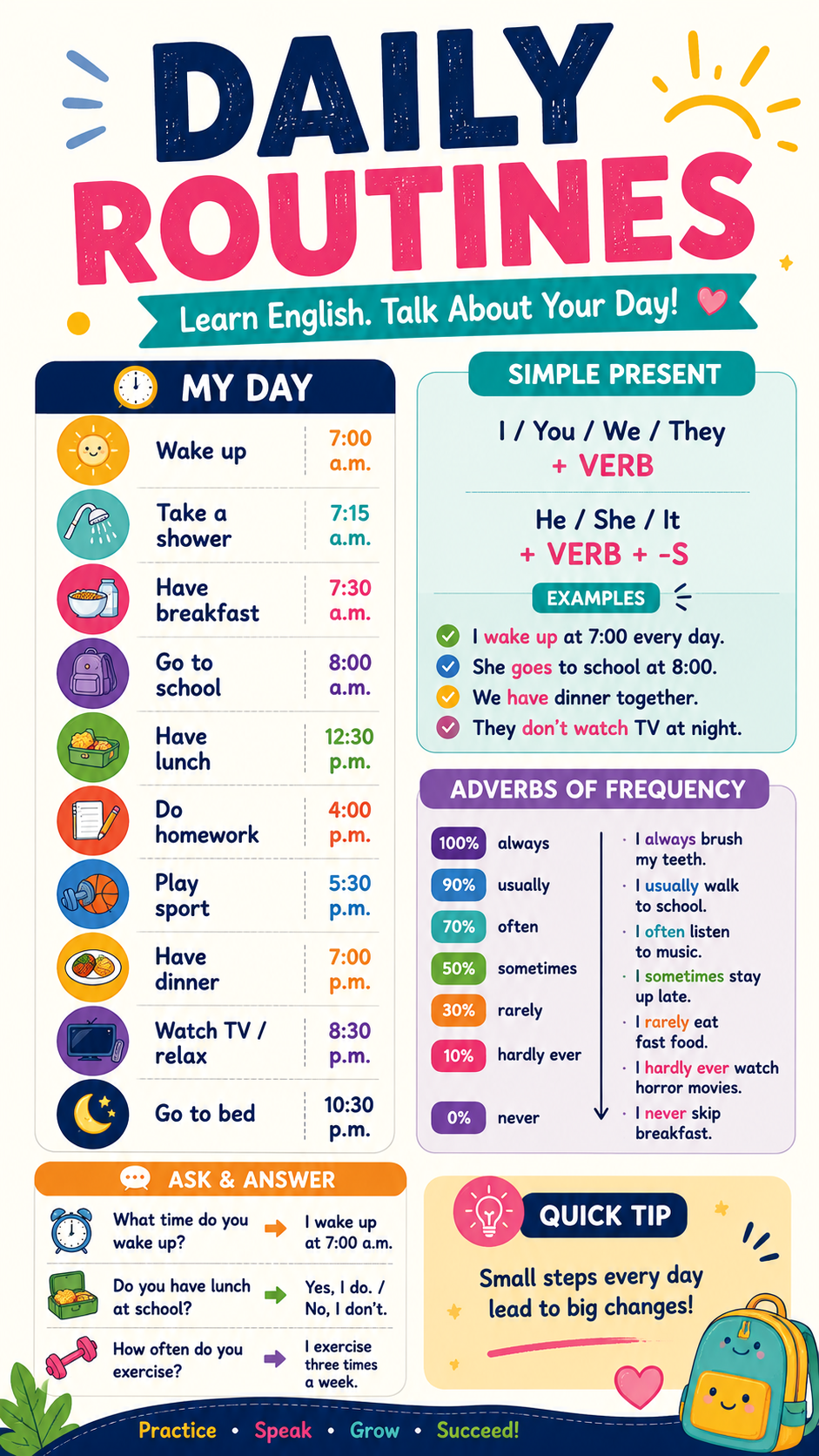
Daily routines are one of the most practical and confidence-building topics for English learners. They connect language to real life, help students talk about their day, and create a natural bridge between vocabulary, grammar, time expressions, and speaking practice. A well-designed daily routines lesson can turn simple phrases like “wake up,” “have breakfast,” and “go to bed” into meaningful communication that learners can use every day.
For young learners, beginners, ESL students, and homeschool families, daily routine vocabulary is especially valuable because it is easy to understand, easy to act out, and easy to personalize. Students are not just memorizing words. They are learning how to describe their mornings, school day, after-school activities, evenings, and habits in complete sentences.
Key Takeaways
- Daily routines help English learners describe real activities in a simple, useful way.
- Routine charts make vocabulary, time, and sentence structure easier to remember.
- Students can practice present simple grammar with verbs such as wake up, go, have, play, and watch.
- Adverbs of frequency help learners explain how often they do everyday activities.
- Ask-and-answer practice builds speaking confidence and classroom interaction.
- Visual icons, colors, and examples make the topic more engaging for kids and beginners.
Why Daily Routines Are Perfect for Beginner English Learners
Daily routines are among the best starting points for English vocabulary lessons because they are familiar to almost everyone. Students already understand the concept of waking up, eating meals, going to school, doing homework, playing sports, relaxing, and sleeping. The lesson becomes less about explaining complicated ideas and more about giving learners the English words and sentence patterns they need to express what they already know.
This makes the topic ideal for ESL classrooms, elementary English lessons, speaking practice, and beginner grammar review. Instead of learning isolated vocabulary, students can connect each phrase to a time of day and a personal habit. For example, “I wake up at 7:00 a.m.” is simple, realistic, and immediately useful.
Important: Daily routine lessons work best when students can talk about their own lives. The more personal the examples feel, the easier it becomes for learners to remember vocabulary and use it naturally in conversation.
Essential Daily Routine Vocabulary
A strong daily routines lesson usually begins with common daily activities. These phrases are simple enough for beginners but flexible enough to support many grammar activities. Learners can use them in sentences, questions, short dialogues, writing tasks, classroom surveys, and speaking games.
Common Morning Routine Words
Morning routines are a natural place to start because students can easily imagine the order of events. Useful phrases include wake up, get up, take a shower, have breakfast, and go to school or go to work. These activities also introduce learners to time expressions such as “at 7:00 a.m.” and “in the morning.”
Teachers can ask students to arrange the actions in order. This helps learners understand sequence while practicing English. A simple activity might be: “First, I wake up. Then, I get up. After that, I take a shower. Finally, I have breakfast.”
School and Afternoon Routine Words
After students learn morning vocabulary, they can move into school and afternoon activities. These may include have lunch, do homework, exercise, play sport, study, listen to music, and clean. These verbs are helpful because they appear often in beginner English lessons and can be reused in many other topics.
For kids, school-related routines are especially relatable. A phrase like “I have lunch at 12:30 p.m.” combines daily routine vocabulary with telling time. “I do homework at 4:00 p.m.” introduces after-school responsibilities and gives students a clear sentence model.
Evening Routine Words
Evening routines help learners complete a full-day description. Useful phrases include have dinner, watch TV, relax, and go to bed. These actions are easy to illustrate, act out, or include in a personal routine chart.
Evening activities are also useful for practicing time in the p.m. format. Students can say, “I have dinner at 7:00 p.m.,” “I watch TV at 8:30 p.m.,” and “I go to bed at 10:30 p.m.” With repetition, learners begin to understand both the vocabulary and the rhythm of present simple sentences.
Teaching Present Simple with Daily Routines
The daily routines topic naturally supports the present simple tense. Students can describe habits using “I,” “you,” “we,” and “they” with the base form of the verb. They can also practice third-person singular sentences with “he,” “she,” and “it,” adding “s” or “es” to the verb when needed.
Simple Sentence Patterns
Beginner learners benefit from clear, repeated sentence structures. For example:
- I wake up at 7:00 a.m. every day.
- We have breakfast in the morning.
- They play basketball after school.
- She goes to school at 8:00 a.m.
- He watches TV in the evening.
These sentences are short, but they teach several important language points at the same time. Students learn subject pronouns, verbs, time phrases, and everyday vocabulary. They also begin to notice that “go” becomes “goes” and “watch” becomes “watches” with “he” or “she.”
Pro Tip: When teaching third-person singular verbs, use daily routine examples that students already know. It is easier to understand “She goes to school” after learners have practiced “I go to school.”
Negative Sentences for Routine Practice
Daily routines are also useful for practicing negative present simple sentences. Students can compare what they do and do not do. For example, “I do not watch TV in the morning” or “They do not play sport every day.” These sentences help learners expand beyond basic positive statements.
Negative examples are especially helpful when discussing habits and preferences. Students can say, “I do not skip breakfast,” “She does not exercise on Mondays,” or “We do not have lunch at home.” This gives them more control over the language and prepares them for real conversation.
Using Time Expressions in Daily Routine Lessons
Time expressions are a key part of describing routines. Without them, students can say what they do, but not when they do it. Adding phrases like “every day,” “every morning,” “in the evening,” “on Mondays,” and “at the weekend” makes routine sentences more complete and natural.
Common Time Expressions to Teach
Beginner-friendly time expressions include:
- every day
- every morning
- every afternoon
- every evening
- on Mondays
- at the weekend
- at 7:00 a.m.
- at 10:30 p.m.
These phrases help learners create fuller answers. Instead of saying “I wake up,” they can say “I wake up at 7:00 a.m. every day.” Instead of saying “I play basketball,” they can say “I play basketball three times a week.”
Combining Time with Routine Verbs
One effective classroom strategy is to give students a list of routine verbs and a list of time expressions, then ask them to combine both into complete sentences. This creates many possible answers and encourages students to think independently.
For example, students can pair “have breakfast” with “every morning,” “do homework” with “at 4:00 p.m.,” or “go to bed” with “at 10:30 p.m.” This kind of practice is simple, but it supports sentence building, grammar accuracy, and speaking fluency.
Why This Matters
Daily routine language is more than a vocabulary topic. It helps learners organize ideas, speak about time, describe habits, and answer everyday questions. This makes it one of the most useful foundations for beginner English communication.
Adverbs of Frequency for Daily Habits
Adverbs of frequency add an important layer to daily routine practice. They help students explain how often they do something. Words like always, usually, often, sometimes, rarely, hardly ever, and never make routine sentences more specific and expressive.
Examples with Adverbs of Frequency
Students can practice sentences such as:
- I always brush my teeth.
- I usually walk to school.
- I often listen to music.
- I sometimes stay up late.
- I rarely eat fast food.
- I hardly ever watch horror movies.
- I never skip breakfast.
These examples help learners talk about habits with more detail. They also encourage students to compare routines with classmates. One student might say, “I always have breakfast,” while another says, “I sometimes have breakfast.” This naturally creates conversation.
Where to Place Adverbs of Frequency
Word order is an important grammar point. In most simple sentences, adverbs of frequency come before the main verb, such as “I always brush my teeth.” However, they usually come after the verb “to be,” as in “I am usually tired in the morning.”
Important: Beginners often remember adverbs of frequency better when they see them on a scale from 100% to 0%. This visual approach makes abstract words like “usually,” “rarely,” and “never” much easier to understand.
Ask-and-Answer Practice for Speaking Confidence
Daily routines are ideal for question-and-answer activities because the questions are practical and easy to personalize. Learners can practice asking classmates about their routines and responding with complete answers. This turns vocabulary into communication.
Useful Daily Routine Questions
Some beginner-friendly questions include:
- What time do you wake up?
- Do you have lunch at school?
- How often do you exercise?
- What do you do after school?
- What time do you go to bed?
These questions introduce different answer types. “What time” questions invite time-based answers. “Do you” questions encourage short answers such as “Yes, I do” or “No, I don’t.” “How often” questions help students use adverbs of frequency or expressions like “three times a week.”
Turning Questions into Classroom Activities
Teachers can use routine questions for pair work, class surveys, speaking circles, and quick warm-up activities. A simple routine interview can be very effective. One student asks, “What time do you wake up?” and the other answers, “I wake up at 7:00 a.m.” Then they switch roles.
For extra practice, students can write down their partner’s answers and report them to the class. This introduces third-person singular grammar in a meaningful way: “She wakes up at 7:00 a.m.” or “He exercises three times a week.”
Creating a Sample Daily Routine
A sample daily routine gives learners a clear model to follow. It shows how individual activities connect into a full-day description. A simple routine might begin with waking up and getting up at 7:00, taking a shower at 7:15, having breakfast at 7:30, going to school at 8:00, doing homework at 4:00, playing basketball at 5:00, having dinner at 7:00, watching TV at 8:30, and going to bed at 10:30.
This kind of sequence is useful because it helps students understand order, time, and sentence flow. Instead of practicing one sentence at a time, they can learn how to describe a complete day.
A Beginner-Friendly Routine Paragraph
Students can use a model paragraph like this:
I wake up at 7:00 a.m. and get up. I take a shower at 7:15. I have breakfast with my family at 7:30. I go to school at 8:00. In the afternoon, I do my homework. I play basketball at 5:00. I have dinner at 7:00. I watch TV and relax in the evening. I go to bed at 10:30 p.m.
After reading a model, students can write their own version. They can change the times, activities, and details to match their real routine. This supports writing practice while keeping the task clear and manageable.
Fun Ways to Practice Daily Routines
Daily routine lessons can be much more engaging when learners move, draw, speak, and personalize their answers. Visual activities, routine cards, and short speaking games are especially effective for kids and beginner ESL students.
Routine Matching Game
Create cards with daily routine phrases and matching pictures. Students match “take a shower” with a shower icon, “have breakfast” with a breakfast image, and “go to bed” with a moon or bed image. This helps visual learners connect meaning with vocabulary.
Put the Day in Order
Give students routine cards and ask them to arrange the activities from morning to night. Then students describe the sequence using words like “first,” “then,” “after that,” and “finally.” This activity builds both vocabulary and storytelling skills.
Classroom Routine Survey
Ask students to interview classmates using questions such as “What time do you wake up?” and “How often do you exercise?” Students can record answers and share results. This encourages real communication and helps learners repeat the same structures with different people.
My Daily Routine Poster
Students can create a colorful daily routine poster with drawings, times, and simple sentences. This works well for classroom displays, homeschool projects, or English notebooks. It also gives learners a finished product they can feel proud of.
Daily Routines for ESL, Homeschool, and Classroom Learning
The daily routines topic fits many learning environments. In an ESL classroom, it supports vocabulary, grammar, listening, speaking, reading, and writing. In homeschool lessons, it connects English practice to a child’s real day. In tutoring sessions, it gives teachers an easy way to assess a learner’s sentence-building skills.
Because the language is practical, students can practice outside the classroom too. They can describe their morning to a parent, write a short diary entry, or answer simple questions about their habits. This repetition helps turn lesson vocabulary into active language.
Important: The best daily routine activities combine structure with personalization. Give learners a clear sentence frame, then let them fill it with their own times, activities, and habits.
How Visual Routine Charts Support Learning
A visual routine chart can make the lesson easier, brighter, and more memorable. Icons for waking up, breakfast, school, homework, sports, dinner, TV, and bedtime give students quick clues. Color-coded sections can separate vocabulary, grammar, adverbs of frequency, questions, and sample routines.
For children, visuals reduce pressure. Students do not need to understand every word immediately because the pictures help guide meaning. For teachers, a routine chart becomes a reusable reference during speaking drills, writing tasks, warm-ups, and review games.
What Makes a Good Daily Routine Chart
A strong routine chart should be organized, readable, and visually friendly. It should include common daily activity verbs, times, example sentences, adverbs of frequency, and question-and-answer models. The layout should help students find information quickly without feeling overwhelmed.
For best results, place the most common vocabulary in one area, grammar examples in another, and speaking prompts in a separate section. This allows learners to use the chart as a step-by-step support tool.
Writing Practice Ideas for Daily Routines
Writing about daily routines is a practical way to review vocabulary and grammar. Students can begin with sentence completion tasks and gradually move toward full paragraphs. The topic is predictable enough to support beginners, yet flexible enough for creative answers.
Sentence Starters
- I wake up at…
- I usually have breakfast…
- After school, I…
- In the evening, I…
- I go to bed at…
These sentence starters give learners confidence. They remove the fear of a blank page and help students focus on vocabulary, time, and personal details.
Short Paragraph Challenge
Once learners can write individual sentences, ask them to write a short paragraph about their day. Encourage them to include at least five routine verbs, three times, and one adverb of frequency. This creates a clear goal while keeping the task beginner-friendly.
At a Glance
- Teach daily routine verbs with pictures and actions.
- Practice present simple sentences with real times.
- Add adverbs of frequency to describe habits.
- Use questions to build speaking confidence.
- Finish with a personal routine paragraph or poster.
Conclusion: Small Daily Routine Lessons Lead to Big Language Growth
Daily routines may look simple, but they create a powerful foundation for English learning. Students practice everyday vocabulary, present simple grammar, time expressions, adverbs of frequency, questions, answers, speaking, and writing all within one familiar topic. That makes daily routines one of the most useful themes for beginner ESL lessons, kids English activities, classroom posters, homeschool practice, and vocabulary review.
When learners can describe their day, they gain more than a list of words. They gain confidence using English to talk about real life. With visual support, clear examples, and plenty of personal practice, a daily routines lesson can become lively, memorable, and genuinely useful.
The key is to keep the lesson simple, colorful, and interactive. Start with common routine verbs, add times, practice short sentences, introduce frequency words, and encourage students to ask and answer questions. Step by step, learners move from naming activities to sharing their own daily lives in English.
Tags
Daily Routines ESL Activities Kids English Daily Routine Vocabulary Present Simple Adverbs of Frequency Classroom Poster Beginner English