
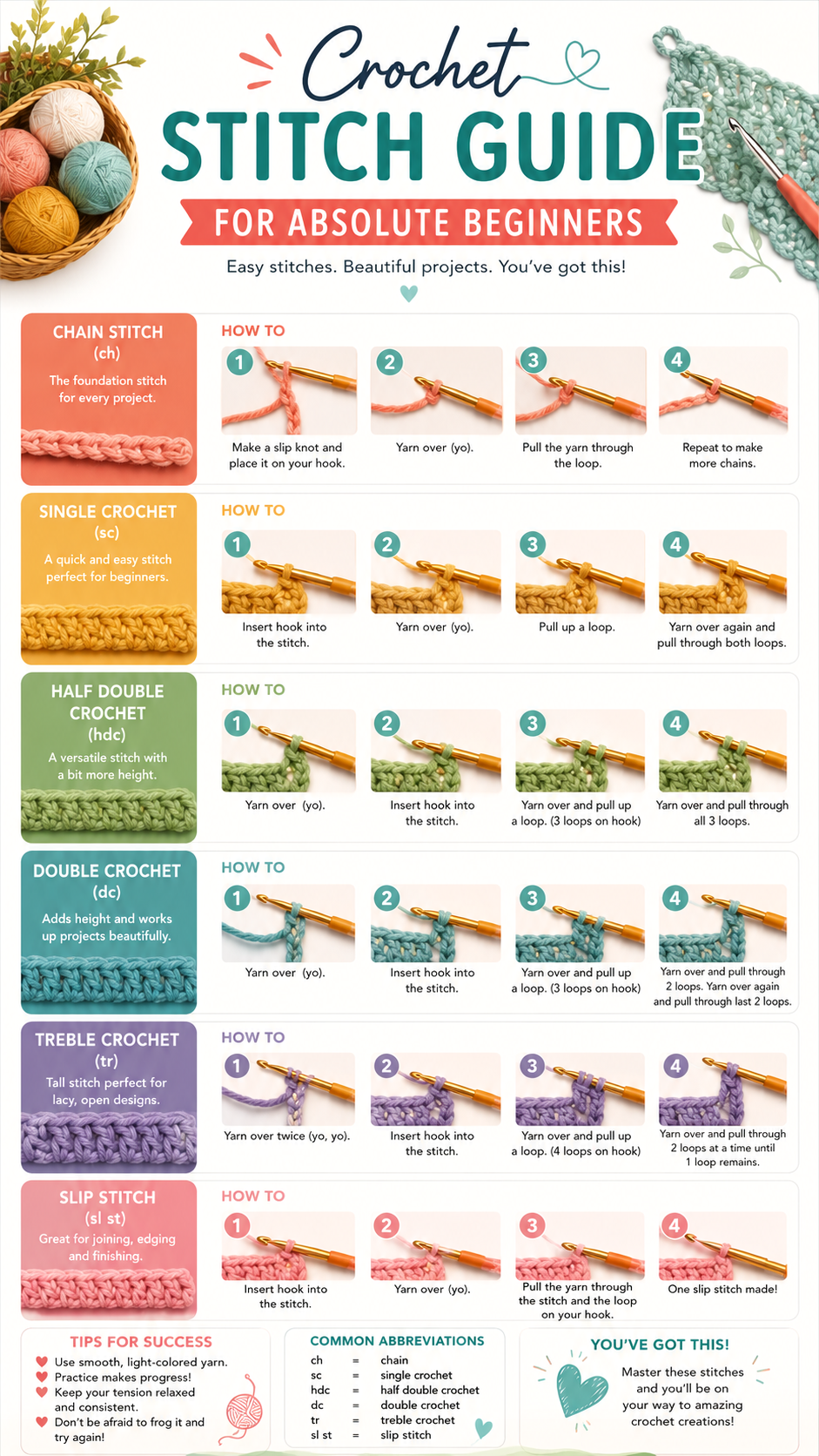
Crochet is one of the most rewarding fiber crafts because it blends creativity, relaxation, and practical skill into a single hobby. Whether your goal is to make cozy blankets, stylish scarves, adorable amigurumi, or elegant home décor, every project begins with learning a handful of essential stitches. Once you understand these core techniques, you’ll have the confidence to read patterns, experiment with new textures, and create handmade items that are both beautiful and functional.
For beginners, crochet can seem intimidating at first. Different stitch names, abbreviations, and hook movements may feel overwhelming. Fortunately, mastering crochet is much easier when you focus on the foundational stitches one at a time. With regular practice and patience, your hands quickly develop the muscle memory needed to crochet smoothly and consistently.
Key Takeaways
- Learn the six essential crochet stitches every beginner should know.
- Understand when each stitch is commonly used.
- Improve stitch consistency with simple practice techniques.
- Become familiar with standard crochet abbreviations.
- Build confidence before tackling larger crochet projects.
Why Learning Basic Crochet Stitches Matters
Every crochet pattern is built from a combination of basic stitches. Once these techniques become second nature, you’ll discover that thousands of projects become accessible. Rather than memorizing dozens of complicated methods, experienced crocheters simply combine familiar stitches in creative ways.
Important: Strong crochet fundamentals lead to cleaner projects, better stitch consistency, easier pattern reading, and fewer frustrating mistakes. Investing time in practicing the basics pays off throughout your entire crochet journey.
Each stitch creates a different texture, height, flexibility, and appearance. Some stitches produce dense fabric perfect for bags or baskets, while others create airy designs that work beautifully for shawls and decorative pieces.
The Six Essential Crochet Stitches
1. Chain Stitch (ch)
The chain stitch is the foundation of nearly every crochet project. Before creating rows or rounds, you’ll typically begin with a chain foundation. Learning to create even, consistent chains makes every future step easier.
- Creates the starting foundation.
- Determines the width of many projects.
- Used throughout patterns for spacing and decorative openings.
Practice maintaining consistent tension while making chains. Chains that are too tight make later rows difficult, while loose chains can leave uneven edges.
2. Single Crochet (sc)
Single crochet is often the first true stitch beginners learn after the foundation chain. It creates a compact, sturdy fabric with minimal gaps.
Because of its dense texture, single crochet is commonly used for:
- Amigurumi
- Dishcloths
- Bags
- Coasters
- Home accessories
Many beginner-friendly projects rely almost entirely on single crochet because it is easy to learn and produces durable results.
3. Half Double Crochet (hdc)
The half double crochet sits between the single crochet and double crochet in height. It works up quickly while still providing a soft, substantial fabric.
Its versatility makes it one of the most frequently used stitches for everyday crochet projects.
- Baby blankets
- Scarves
- Beanies
- Sweaters
- Throw blankets
Expert Insight
Many experienced crocheters consider the half double crochet one of the most versatile stitches because it balances speed, softness, durability, and visual appeal. If you’re only learning a few stitches initially, this one deserves extra practice.
4. Double Crochet (dc)
Double crochet creates taller stitches that cover more area with fewer rows. This makes projects grow noticeably faster than when using single crochet.
Its open texture also creates fabric with better drape, making it ideal for wearable items.
- Afghans
- Cardigans
- Lightweight blankets
- Shawls
- Market bags
Because the stitch is taller, maintaining even tension becomes even more important for achieving professional-looking results.
5. Treble Crochet (tr)
Treble crochet produces tall, elegant stitches with noticeable spacing between them. This stitch is perfect when creating airy, decorative fabrics.
It is commonly found in lace patterns, wraps, decorative borders, and lightweight garments.
Pro Tip: Tall stitches like treble crochet can easily become uneven if your yarn tension changes frequently. Slow down while practicing until each stitch matches the previous one in height.
6. Slip Stitch (sl st)
Although small, the slip stitch is incredibly important. It joins rounds, moves yarn across a project without adding height, and creates clean finishing edges.
You’ll use slip stitches regularly even after becoming an advanced crocheter.
- Joining rounds
- Finishing projects
- Creating decorative edging
- Moving to a new stitch location
Understanding Crochet Abbreviations
Most crochet patterns use abbreviations instead of writing full stitch names repeatedly. Learning these shorthand terms makes reading patterns much easier.
| Abbreviation | Meaning |
|---|---|
| ch | Chain Stitch |
| sc | Single Crochet |
| hdc | Half Double Crochet |
| dc | Double Crochet |
| tr | Treble Crochet |
| sl st | Slip Stitch |
Tips for Better Crochet Results
Improving your crochet isn’t about working faster. It’s about developing consistency through mindful practice.
- Choose smooth, light-colored yarn when learning.
- Use an appropriately sized crochet hook.
- Practice maintaining even tension.
- Count stitches at the end of every row.
- Read patterns completely before beginning.
- Don’t hesitate to unravel mistakes and try again.
Many beginners become discouraged after making small mistakes. Remember that experienced crocheters also unravel rows regularly. Frogging, which means pulling out stitches to correct errors, is a normal part of the crafting process.
Choosing the Right Yarn for Practice
Your first yarn choice has a significant impact on your learning experience. Smooth worsted-weight yarn is generally the easiest to work with because individual stitches remain easy to identify.
Avoid fuzzy novelty yarns during your first projects. Their texture can hide stitches, making counting and correction much more difficult.
Neutral or light-colored yarn also improves visibility, allowing you to clearly see loops, stitch placement, and row progression.
Common Beginner Mistakes
Every new crocheter experiences similar challenges. Recognizing these issues early helps you improve faster.
- Accidentally adding or losing stitches.
- Pulling yarn too tightly.
- Using inconsistent tension.
- Skipping turning chains.
- Misreading pattern instructions.
- Choosing overly difficult projects too soon.
Important: Don’t judge your early work too harshly. Consistency develops gradually. Every completed practice swatch strengthens your technique and builds confidence for future projects.
Simple Projects to Practice Basic Stitches
Once you’ve mastered the six foundational stitches, begin applying them in small projects that reinforce your new skills.
- Washcloths
- Coasters
- Bookmarks
- Simple scarves
- Headbands
- Mug cozies
- Baby blankets
- Pillow covers
Each project introduces repetition, helping your hands naturally memorize stitch movements while producing useful handmade items.
At a Glance
- Master the chain stitch before moving to other techniques.
- Practice consistent yarn tension every session.
- Learn crochet abbreviations to read patterns confidently.
- Start with simple projects before attempting advanced designs.
- Regular practice is the fastest path to improvement.
Conclusion
Learning crochet starts with understanding a small collection of foundational stitches that unlock countless creative possibilities. The chain stitch, single crochet, half double crochet, double crochet, treble crochet, and slip stitch each serve a unique purpose while working together to create endless textures and designs.
As your confidence grows, these stitches become second nature, allowing you to focus less on technique and more on creativity. Whether you’re crafting thoughtful handmade gifts, decorating your home, or simply enjoying a relaxing hobby, strong crochet basics provide the foundation for every successful project. Practice consistently, embrace mistakes as learning opportunities, and enjoy watching your skills improve with every completed stitch.
Tags
Crochet Basics Crochet Stitches Beginner Crochet Learn to Crochet Crochet Tutorial Yarn Crafts DIY Crafts Fiber Arts