
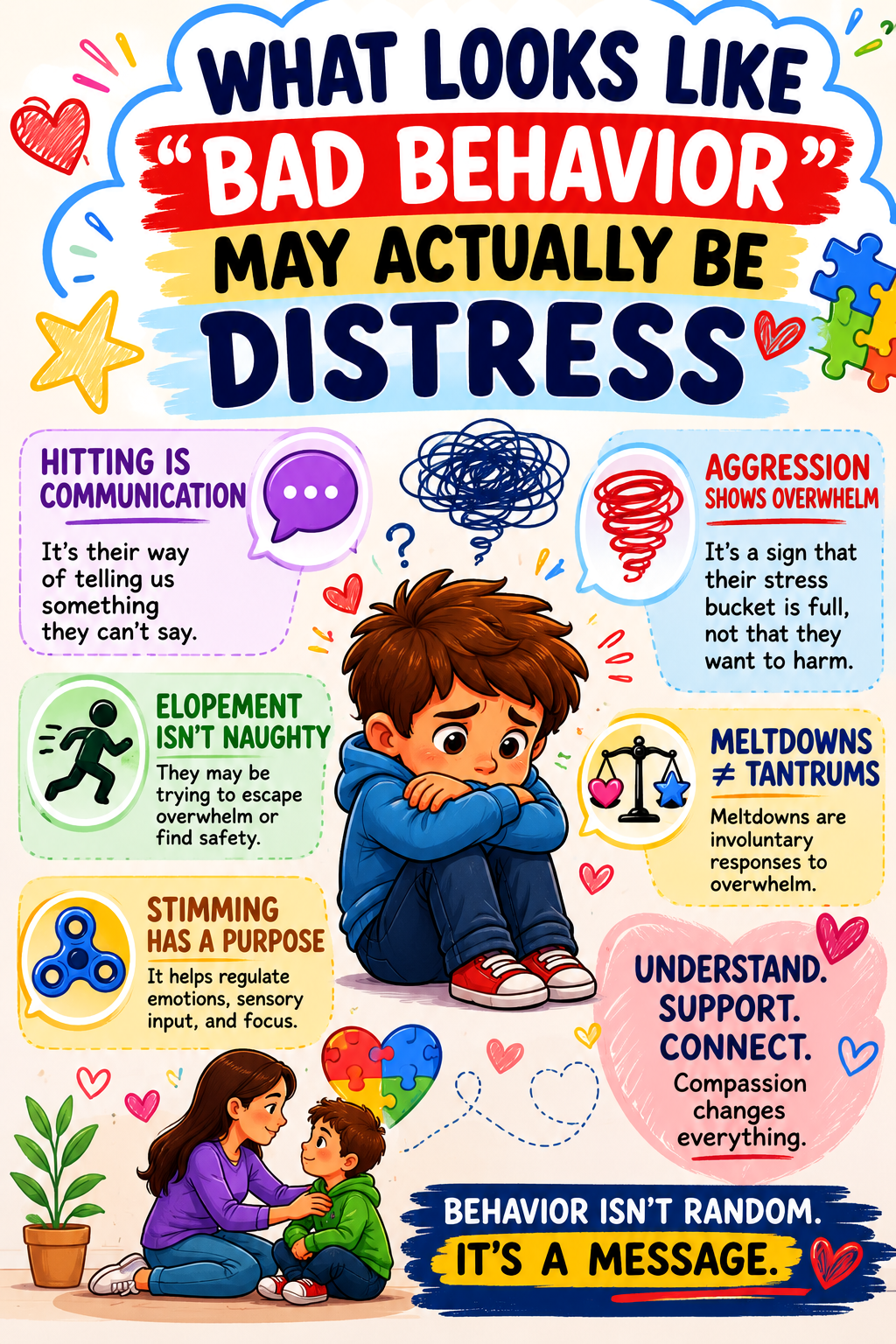
Many behaviors that are commonly labeled as “bad” or “challenging” are often misunderstood forms of communication. For autistic children and individuals with sensory processing differences, actions such as hitting, running away, stimming, aggression, or emotional outbursts may not be intentional acts of defiance. Instead, they can be signals of distress, overwhelm, anxiety, discomfort, or unmet needs.
When caregivers, educators, and family members shift their perspective from punishment to understanding, they create opportunities for meaningful support and connection. Recognizing the reasons behind behaviors can transform relationships, reduce conflict, and help children feel safe, heard, and respected.
Key Takeaways
- Behavior is often a form of communication.
- Many challenging actions stem from stress, sensory overload, or unmet needs.
- Meltdowns differ significantly from tantrums.
- Stimming serves important self-regulation functions.
- Compassion and understanding improve outcomes.
- Supportive responses build trust and emotional safety.
Understanding Behavior Through a Different Lens
For years, many developmental and behavioral approaches focused primarily on stopping unwanted behaviors. While safety and appropriate boundaries remain important, modern understanding emphasizes the importance of identifying what behavior is trying to communicate.
Every behavior has a purpose. Whether a child is withdrawing, yelling, hitting, running away, or repeating movements, there is often an underlying reason driving the action. Looking beyond the surface helps adults respond more effectively.
Important: When behavior is viewed as communication rather than disobedience, adults can focus on solving the underlying problem instead of simply reacting to the visible action.
Children may struggle to express emotions, sensory discomfort, fear, confusion, pain, frustration, or exhaustion through words. Their behavior becomes the message. Learning to interpret that message can dramatically improve support strategies.
Why Challenging Behaviors Often Reflect Distress
Distress can appear in many forms. Some children become loud and active, while others become quiet and withdrawn. Stress responses vary from person to person.
Common causes of distress include:
- Sensory overload from noise, lights, textures, or crowds
- Communication difficulties
- Unexpected changes in routine
- Anxiety and uncertainty
- Physical discomfort or illness
- Fatigue and emotional exhaustion
- Social challenges
- Feeling misunderstood or unsupported
Understanding these potential triggers allows caregivers to address root causes rather than focusing exclusively on symptoms.
When Hitting Is a Form of Communication
Physical aggression can be one of the most difficult behaviors for adults to manage. However, in many situations, hitting may reflect a child’s inability to communicate intense feelings or needs.
A child who hits may be experiencing:
- Extreme frustration
- Fear or anxiety
- Sensory overwhelm
- Communication barriers
- Difficulty regulating emotions
While aggressive behavior should never be ignored, understanding the reason behind it helps guide a more supportive response. Teaching alternative communication skills, identifying triggers, and creating calming strategies can often reduce future incidents.
Responding Effectively
Instead of immediately assuming malicious intent, adults can ask:
- What happened before the behavior?
- Is the child overwhelmed?
- Are they struggling to communicate?
- Has something changed in their environment?
These questions create opportunities for understanding rather than escalating the situation.
Understanding Elopement and Running Away
Elopement refers to leaving a safe environment without permission or supervision. It is often misunderstood as intentional misbehavior, but many autistic individuals run because they are trying to escape something distressing or move toward something they perceive as safe.
Reasons for elopement may include:
- Escaping sensory overload
- Avoiding stressful situations
- Seeking a preferred environment
- Following a strong interest
- Feeling unsafe or overwhelmed
Safety remains the priority, but understanding motivations helps families and professionals develop prevention strategies.
Why This Matters
When adults understand the reason behind elopement, they can create safer environments, reduce stress triggers, and teach replacement skills that better meet the individual’s needs.
The Important Purpose of Stimming
Stimming, short for self-stimulatory behavior, includes repetitive movements, sounds, or actions. Examples may include rocking, hand movements, humming, fidgeting, or interacting with sensory objects.
For many autistic individuals, stimming serves valuable functions.
Benefits of Stimming
- Supports emotional regulation
- Provides sensory input
- Improves focus and concentration
- Reduces anxiety
- Helps process overwhelming situations
- Creates feelings of comfort and predictability
Rather than automatically discouraging stimming, it is important to understand whether the behavior is helping the individual self-regulate. Many forms of stimming are harmless and beneficial.
Pro Tip: Before trying to stop a repetitive behavior, ask what purpose it serves. If it helps regulate emotions or sensory needs and does not create harm, supporting it may be more beneficial than eliminating it.
When Aggression Signals Overwhelm
Aggressive behaviors often emerge when an individual’s internal stress level becomes too high. Some experts describe this as a stress bucket that gradually fills throughout the day.
Stress may accumulate from:
- Sensory challenges
- Social expectations
- Communication difficulties
- Unexpected changes
- Fatigue
- Academic or daily demands
Once the stress bucket reaches capacity, a seemingly small event may trigger a significant reaction.
Recognizing early warning signs is often more effective than responding only after escalation occurs. These signs may include restlessness, increased stimming, withdrawal, irritability, or difficulty concentrating.
Building Emotional Regulation Skills
Supportive strategies may include:
- Providing predictable routines
- Offering sensory breaks
- Teaching emotional vocabulary
- Using visual supports
- Creating calm spaces
- Reducing unnecessary demands during stressful moments
Meltdowns and Tantrums Are Not the Same
One of the most important distinctions for caregivers and educators is understanding the difference between a meltdown and a tantrum.
A tantrum is generally goal-oriented. A child may want something specific, such as a toy, activity, or preferred outcome.
A meltdown, on the other hand, is an involuntary response to overwhelming stress, sensory overload, or emotional dysregulation. During a meltdown, the individual often loses the ability to cope effectively with their environment.
Characteristics of Meltdowns
- Triggered by overwhelm
- Not intentional manipulation
- Often continues regardless of rewards or consequences
- Requires support and recovery time
- Can be physically and emotionally exhausting
Characteristics of Tantrums
- Usually linked to a desired outcome
- May stop when the goal changes
- Typically involve conscious behavior choices
- Often decrease when attention is removed
Important: Treating a meltdown like a tantrum can increase distress and prolong recovery. Supportive responses focus on reducing overwhelm rather than enforcing consequences during the crisis.
How Compassion Changes Outcomes
Compassion does not mean ignoring boundaries or safety concerns. Instead, it means responding with curiosity, empathy, and understanding.
Children thrive when they feel safe and supported. When adults consistently seek to understand behavior, trust grows. This trust creates stronger relationships and improves communication over time.
Compassionate approaches often include:
- Listening without judgment
- Validating emotions
- Identifying unmet needs
- Providing accommodations when appropriate
- Teaching skills rather than relying solely on punishment
- Celebrating progress instead of perfection
Supporting Autistic Children at Home and School
Both families and educators play important roles in creating supportive environments. Consistency across settings often helps children feel more secure.
Practical Strategies for Parents
- Observe patterns and triggers
- Create predictable routines
- Offer clear communication
- Provide sensory-friendly spaces
- Model emotional regulation skills
- Focus on connection before correction
Practical Strategies for Educators
- Use visual schedules
- Provide transition warnings
- Allow sensory breaks
- Maintain consistent expectations
- Build positive relationships
- Adapt environments when possible
Creating a More Understanding World
Awareness and education are essential for creating inclusive communities. As understanding of autism and neurodiversity continues to grow, more people are recognizing that behavior often reflects an individual’s experience rather than their character.
Replacing judgment with curiosity can transform interactions. Instead of asking, “How do we stop this behavior?” a more productive question may be, “What is this person trying to tell us?”
At a Glance
- Behavior often communicates unmet needs.
- Stimming supports emotional and sensory regulation.
- Aggression can indicate overwhelming stress.
- Elopement may be an attempt to seek safety or escape distress.
- Meltdowns are involuntary responses to overwhelm.
Conclusion
Understanding the connection between behavior and distress is one of the most powerful shifts caregivers, educators, and communities can make. Behaviors that appear challenging on the surface often reveal important information about emotional, sensory, communication, or environmental needs.
By approaching behavior with empathy, curiosity, and respect, we move beyond punishment and toward meaningful support. This approach helps autistic individuals feel understood, strengthens relationships, and creates environments where everyone has the opportunity to thrive. Compassion, connection, and understanding truly can change everything.
Tags
Autism Awareness Neurodiversity Autism Parenting Meltdowns Sensory Processing Special Education Behavior Communication Emotional Regulation